
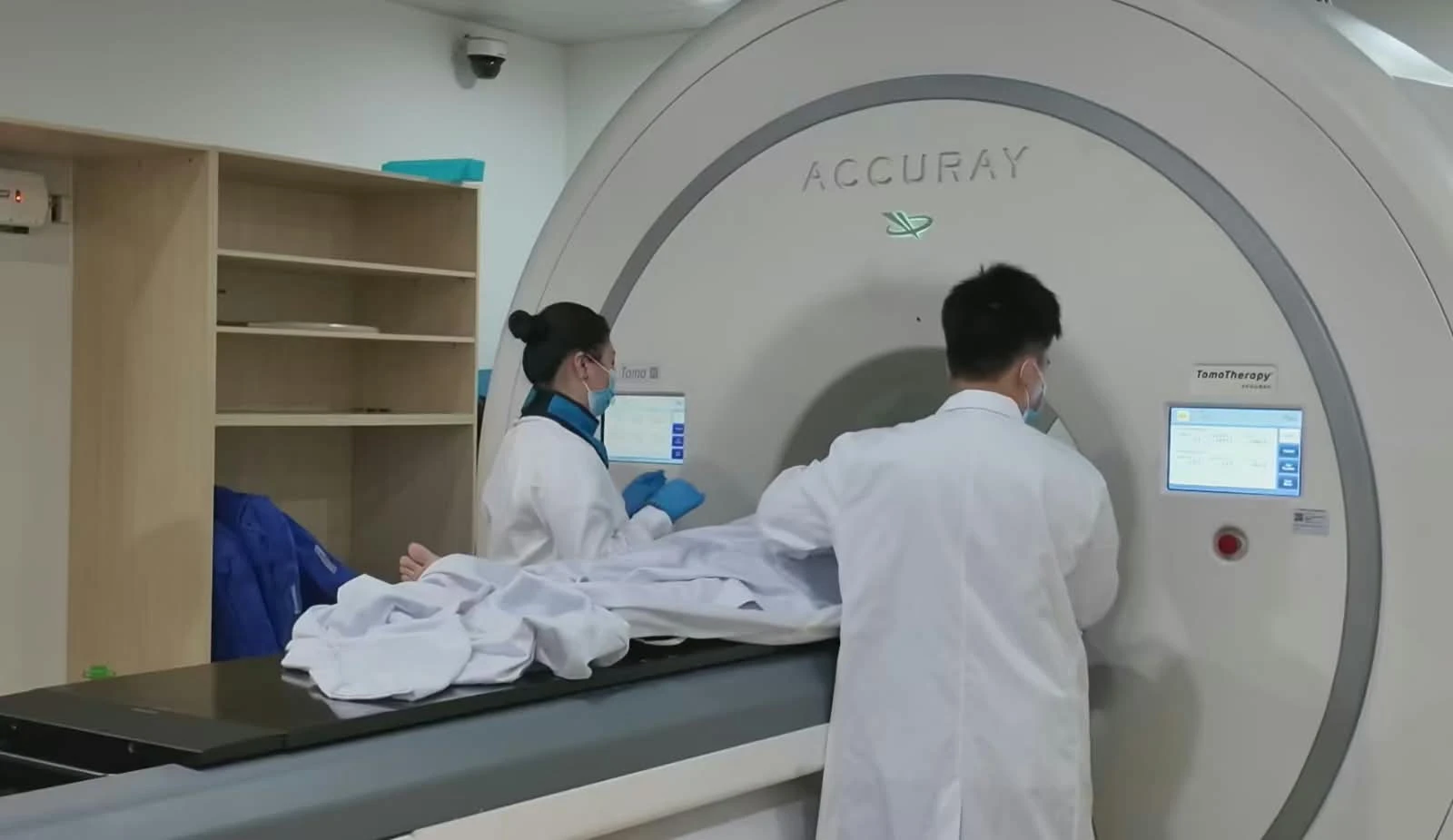
Treatment Overview & Clinical Details
1. What Is TomoTherapy®?
TomoTherapy® is an advanced form of radiation therapy that integrates image-guided radiation therapy (IGRT) with highly precise radiation delivery. It uses a rotating radiation beam and advanced treatment planning to deliver radiation to tumors from multiple angles while helping minimize radiation exposure to surrounding healthy tissues.
TomoTherapy is designed to provide highly conformal radiation treatment and can be particularly useful for tumors with complex shapes, locations, or treatment requirements.
2. How Does TomoTherapy® Work?
TomoTherapy is based on advanced image-guided radiation therapy (IGRT) and computer-controlled radiation delivery. The treatment process generally involves the following steps:
1. Image Acquisition
CT imaging is used to obtain detailed three-dimensional images of the patient’s tumor and surrounding anatomical structures.
2. Treatment Planning
Based on the imaging data, the radiation oncology team develops an individualized treatment plan. The treatment plan determines the radiation dose, target areas, beam configuration, and other treatment parameters.
3. Rotational Radiation Delivery
During treatment, the TomoTherapy system rotates around the patient while delivering radiation from multiple angles. The radiation beam is modulated and shaped to conform to the target, allowing the prescribed dose to be delivered as accurately as possible.
4. Image Guidance and Position Verification
Imaging is used to verify the patient’s position before and/or during treatment, depending on the treatment system and clinical protocol. This helps ensure that radiation is delivered accurately to the intended treatment area.
3. Advantages of TomoTherapy®
Compared with some conventional radiation therapy techniques, TomoTherapy may offer several potential advantages:
1. High Precision
Advanced treatment planning and image guidance allow radiation to be precisely targeted to the tumor while helping reduce unnecessary radiation exposure to nearby healthy tissues.
2. Flexible Treatment Planning
TomoTherapy can create highly conformal dose distributions and may be particularly useful for tumors with complex shapes, locations, or treatment volumes.
3. Image-Guided Treatment
Integrated imaging allows the medical team to verify patient positioning and treatment anatomy, helping improve the accuracy and reproducibility of radiation delivery.
4. Potentially Reduced Side Effects
By optimizing the radiation dose distribution and limiting exposure to surrounding healthy tissues, TomoTherapy may reduce certain treatment-related side effects in appropriately selected patients.
However, side effects depend on the tumor location, radiation dose, treatment area, and individual patient factors.
4. Conditions That May Be Treated with TomoTherapy®
TomoTherapy may be used to treat a wide range of cancers, depending on the individual patient’s condition and treatment plan.
Potential applications include:
Head and Neck Tumors
Examples include selected cancers of the larynx, oral cavity, pharynx, and other head and neck structures.
Thoracic Tumors
Examples include selected cases of lung cancer and esophageal cancer.
Abdominal Tumors
Examples include selected liver, pancreatic, and other abdominal tumors.
Bone and Soft-Tissue Tumors
TomoTherapy may be considered for selected bone and soft-tissue tumors when clinically appropriate.
Recurrent Tumors
In selected cases, TomoTherapy may be considered for recurrent tumors, including situations in which previous radiation therapy has been performed.
Reirradiation requires particularly careful evaluation because previous radiation exposure can affect the tolerance of surrounding healthy tissues.
Important: Whether TomoTherapy is appropriate depends on the cancer type, stage, tumor location and size, previous treatments, overall health, and treatment goals. A radiation oncologist and multidisciplinary medical team should evaluate each patient individually.
5. TomoTherapy® Treatment Process
1. Medical Evaluation
The physician reviews the patient’s diagnosis, pathology, imaging studies, previous treatments, overall health, and other relevant medical information to determine whether TomoTherapy is an appropriate treatment option.
2. CT Simulation and Imaging
A CT simulation is performed to accurately identify the tumor and surrounding organs and tissues. Additional imaging, such as MRI or PET/CT, may be incorporated when clinically appropriate.
3. Individualized Treatment Planning
The radiation oncology team develops a personalized treatment plan based on the patient’s anatomy and treatment goals. The plan specifies the target volume, radiation dose, beam configuration, and dose constraints for nearby organs at risk.
4. Treatment Delivery
The patient lies on the treatment table while the TomoTherapy system rotates around the body and delivers radiation from multiple angles.
Image guidance may be used to verify positioning and anatomy before treatment and, depending on the system and protocol, during treatment.
5. Follow-Up
After completing treatment, patients receive regular follow-up evaluations. Follow-up may include physical examinations, CT or MRI scans, laboratory tests, and other assessments to monitor treatment response and potential short- or long-term side effects.
6. TomoTherapy® vs. Conventional Radiation Therapy
| Feature | TomoTherapy® | Conventional Radiation Therapy |
| Treatment Precision | Highly precise, image-guided radiation delivery | Precision varies depending on the technique and equipment used |
| Image Guidance | Integrated image-guidance capabilities for patient positioning and treatment verification | Depends on the radiation therapy system and treatment protocol |
| Dose Distribution | Highly conformal and intensity-modulated dose distribution | Dose distribution varies according to the specific radiation technique |
| Treatment of Complex Tumors | Can be particularly useful for selected tumors with complex shapes or locations | Also used for a broad range of tumors, depending on the treatment technique |
| Potential Side Effects | May reduce exposure to certain healthy tissues in appropriately planned treatments | Varies according to treatment technique, dose, and treatment area |
| Treatment Planning | Advanced computer-based treatment planning and dose optimization | Varies depending on the treatment system and technique |
7. Important Considerations
When considering TomoTherapy treatment, several factors should be taken into account:
Pre-Treatment Evaluation
A comprehensive medical evaluation should be performed to determine whether TomoTherapy is clinically appropriate for the patient’s specific condition.
Equipment Quality and Calibration
Radiation therapy equipment must undergo regular quality assurance, calibration, and maintenance in accordance with applicable medical and manufacturer standards.
Patient Cooperation
Patients should remain as still as possible during treatment. Proper positioning and immobilization are important for accurate radiation delivery.
Monitoring of Side Effects
Patients should be monitored for potential treatment-related side effects. Any significant or unexpected symptoms should be promptly reported to the medical team.
Follow-Up Care
A personalized follow-up plan should be established to evaluate treatment response, monitor disease status, and manage any potential short- or long-term treatment effects.
8. Important Reminder
TomoTherapy® is an advanced radiation therapy technology, but it does not guarantee a cure and is not necessarily superior to every other radiation therapy technique for every patient.
The most appropriate treatment depends on the patient’s cancer type, stage, tumor location, anatomy, previous treatment history, overall health, and treatment objectives.
Patients should consult with a qualified radiation oncologist to determine whether TomoTherapy, conventional photon radiation therapy, proton therapy, stereotactic radiation therapy, surgery, systemic therapy, or a combination of treatments is most appropriate for their individual situation.