
Treatment Overview & Clinical Details
1. What Is CyberKnife®?
CyberKnife® is a non-invasive, highly precise radiation therapy system that delivers stereotactic radiosurgery (SRS) or stereotactic body radiation therapy (SBRT) to tumors and other abnormal tissues.
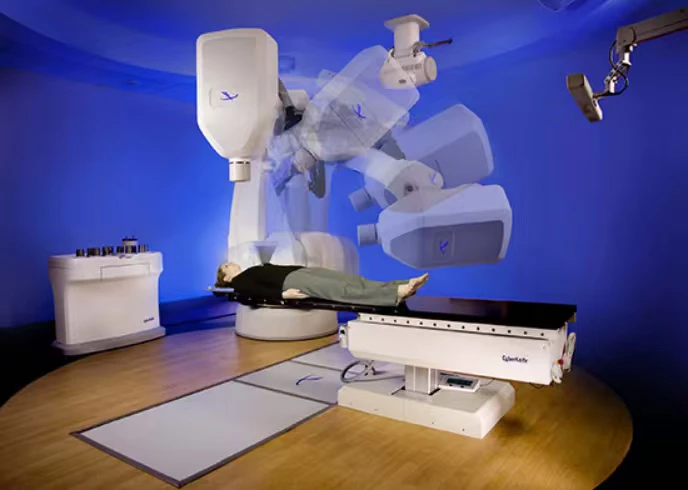
Despite its name, CyberKnife is not a surgical knife and does not physically cut into the body. Instead, it uses a compact linear accelerator mounted on a robotic arm to deliver multiple highly focused beams of radiation from different angles.
By precisely targeting the tumor while minimizing radiation exposure to surrounding healthy tissue, CyberKnife can deliver high-dose radiation to selected tumors without the need for a conventional surgical incision.
2. How Does CyberKnife® Work?
CyberKnife combines advanced imaging, computer-controlled treatment planning, and robotic technology to deliver highly precise radiation therapy.
The treatment process generally involves the following:
1. Image-Guided Targeting
Before and during treatment, imaging technology is used to identify the location of the tumor and surrounding anatomical structures.
2. Real-Time Tracking
CyberKnife can continuously monitor the position of the treatment target. Depending on the tumor location and treatment system, motion caused by breathing or other patient movement can be accounted for during treatment.
3. Robotic Beam Delivery
A robotic arm moves around the patient and delivers radiation beams from multiple directions. This allows radiation to be concentrated on the tumor while helping limit the dose received by surrounding healthy tissues.
4. High-Dose, Precise Radiation
CyberKnife delivers highly focused radiation to the treatment target. Rather than physically removing the tumor, the radiation damages the DNA of tumor cells and prevents them from continuing to grow and divide.
3. Advantages of CyberKnife®
1. Non-Invasive Treatment
CyberKnife does not require a surgical incision. This may make it an option for patients who are not good candidates for conventional surgery or for selected tumors located in difficult-to-access areas.
2. High Precision
Radiation can be delivered from multiple directions and concentrated on the target. Advanced image guidance and robotic positioning help improve treatment accuracy.
3. Motion Tracking
For certain tumors that move with respiration, such as some lung or liver tumors, CyberKnife’s motion-management capabilities can help account for tumor movement during treatment.
4. Short Treatment Course
Unlike many conventional radiation therapy schedules that may require several weeks of treatment, stereotactic treatments can often be completed in a relatively small number of sessions.
The exact number of treatment sessions depends on the tumor type, size, location, and individual treatment plan.
5. Outpatient Treatment
CyberKnife treatment is generally performed on an outpatient basis. Hospitalization is usually not required solely for the radiation treatment, although individual circumstances may vary.
6. Potentially Less Impact on Healthy Tissue
Because radiation can be delivered from multiple directions and precisely shaped around the target, CyberKnife may reduce radiation exposure to nearby healthy tissues in appropriately selected patients.
4. Conditions That May Be Treated with CyberKnife®
CyberKnife may be considered for selected patients with tumors and other conditions, including:
- Brain tumors
- Brain metastases
- Spinal tumors
- Lung tumors and selected lung metastases
- Liver tumors and selected liver metastases
- Prostate cancer
- Pancreatic tumors in selected cases
- Head and neck tumors
- Selected recurrent or metastatic tumors
- Other localized tumors or lesions that may benefit from stereotactic radiation therapy
CyberKnife may be used as a primary treatment, an alternative to surgery in selected patients, or as part of a broader multidisciplinary treatment plan.
Suitability depends on factors such as tumor size, location, number of lesions, proximity to critical organs, previous treatments, overall health, and the patient’s treatment goals.
5. CyberKnife® Treatment Process
1. Medical Evaluation
A radiation oncologist and multidisciplinary medical team review the patient’s medical history, pathology, imaging studies, tumor characteristics, previous treatments, and overall health.
The team determines whether CyberKnife is an appropriate treatment option.
2. Treatment Planning and Imaging
High-resolution CT and/or MRI scans may be performed to accurately define the treatment target and surrounding organs.
Depending on the treatment area, a customized immobilization device may be used to help maintain the patient’s position.
3. Treatment Planning
Specialized software is used to develop an individualized radiation treatment plan.
The radiation oncology team determines the appropriate radiation dose, beam directions, treatment margins, and other parameters while attempting to protect nearby critical structures.
4. CyberKnife Treatment
During treatment, the patient lies comfortably on the treatment table while the robotic arm moves around the body and delivers radiation from multiple angles.
The system uses image guidance to verify the target position and adjust radiation delivery as needed.
The patient does not feel the radiation during treatment.
5. Post-Treatment Follow-Up
After treatment, patients usually return home the same day.
Follow-up appointments may include physical examinations and imaging studies such as CT or MRI to evaluate treatment response and monitor for potential side effects.
6. CyberKnife® vs. Conventional Surgery and Radiation Therapy
| Feature | CyberKnife® | Conventional Surgery | Conventional Radiation Therapy |
| Treatment Method | Highly focused stereotactic radiation | Surgical removal of tissue | Radiation delivered using conventional photon-based techniques |
| Surgical Incision | No | Usually required | No |
| Anesthesia | Usually not required for the radiation treatment itself | Often required | Usually not required |
| Treatment Sessions | Often completed in a small number of sessions | Usually a single surgical procedure, followed by recovery | Often requires multiple sessions over several weeks |
| Tumor Removal | Does not physically remove the tumor | Physically removes the tumor | Does not physically remove the tumor |
| Precision | Highly precise, image-guided radiation delivery | Depends on surgical access and anatomy | Precise, but treatment characteristics differ from stereotactic radiation |
| Recovery | Generally minimal recovery from the treatment itself | May require significant postoperative recovery | Usually no surgical recovery required |
| Typical Applications | Selected localized tumors and lesions | Resectable tumors and other surgical conditions | Broad range of cancers and clinical situations |
7. CyberKnife® Limitations and Potential Side Effects
CyberKnife is not appropriate for every patient or every type of tumor.
Potential limitations include:
- Very large tumors may not be suitable for stereotactic treatment.
- Tumors located immediately adjacent to certain critical organs may require alternative treatment strategies.
- Widespread metastatic disease may require systemic therapy rather than localized radiation alone, although selected metastatic lesions may still be treated with stereotactic radiation.
- Previous radiation therapy may affect whether CyberKnife can safely be used again.
- Treatment effectiveness depends on tumor type, tumor biology, size, location, and other individual factors.
Although CyberKnife is non-invasive, it is still a form of radiation therapy and can cause side effects.
Possible side effects vary according to the treatment site and radiation dose and may include:
- Fatigue
- Temporary swelling or inflammation
- Skin reactions in some treatment areas
- Headache or neurological symptoms following treatment of certain brain lesions
- Organ-specific side effects depending on the location of the tumor
Patients should discuss potential risks and expected benefits with their radiation oncology team before treatment.
8. Important Considerations
CyberKnife Does Not Guarantee a Cure
CyberKnife is an advanced radiation treatment technology, but it does not guarantee tumor eradication or cure.
Treatment outcomes depend on the cancer type, stage, tumor biology, size and location, previous treatments, and the patient’s overall health.
Individualized Treatment Is Essential
The decision to undergo CyberKnife treatment should be based on a comprehensive evaluation by a qualified radiation oncology team.
In many cases, CyberKnife may be combined with or used alongside other treatments, including surgery, chemotherapy, targeted therapy, immunotherapy, or conventional radiation therapy.
A Second Opinion May Be Appropriate
For patients considering CyberKnife, particularly those with complex, recurrent, or previously treated tumors, obtaining an evaluation from an experienced radiation oncology center may help determine whether stereotactic radiation therapy is appropriate.
9. Summary
CyberKnife® is a non-invasive, image-guided robotic radiation therapy technology designed to deliver highly precise radiation to selected tumors and lesions.
Unlike conventional surgery, CyberKnife does not physically cut or remove the tumor. Instead, it uses precisely targeted radiation to damage tumor cells.
For appropriately selected patients, CyberKnife may offer an alternative to surgery or a highly focused radiation treatment option, with the potential for a shorter treatment course and minimal interruption to daily life.
The suitability of CyberKnife should always be determined on an individual basis by a qualified multidisciplinary medical team.